
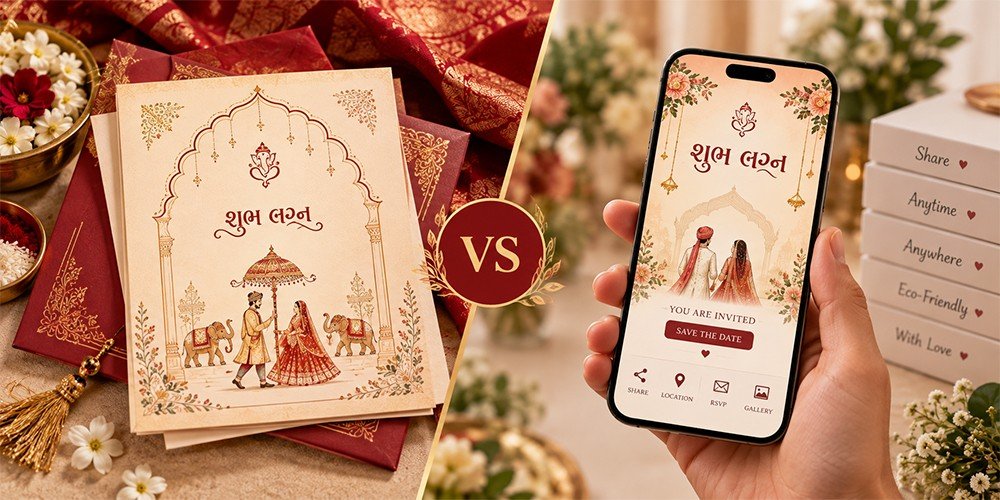
A Gujarati wedding invitation is more than a card with a date and venue. It introduces the family, shares the wedding functions, and sets the tone for the celebration.
Today, families can choose a digital Kankotri or a traditional Kankotri. Both formats have their own place. The right choice often depends on who will receive the invitation, how the family wants to share it, and how much traditional detail they want to include.
For many Gujarati families, using both formats can also be a practical option.
Digital Kankotri vs Traditional Kankotri: What Is the Difference?
The main difference is the format in which the wedding invitation reaches your guests.
A traditional Kankotri is a printed wedding invitation that is physically given to family members, relatives, friends, and other guests.
A digital Kankotri is shared through smartphones and digital platforms such as WhatsApp. It can be created as a video invitation, PDF invitation, or both.
Both can include Gujarati wording, family names, wedding dates, venues, functions, blessings, photos, and traditional wedding elements.
What Is a Traditional Kankotri?
A traditional Kankotri is a physical Gujarati wedding invitation card.
Families often give printed cards personally to close relatives and elders. The card may include religious symbols, Gujarati wedding wording, family names, function details, and other traditional elements.
For many families, giving a Kankotri personally is part of the invitation process itself. It allows relatives to meet, exchange blessings, and talk about the upcoming wedding.
What Is a Digital Kankotri?
A digital Kankotri is an electronic wedding invitation that can be shared using a smartphone.
It can be created as a video, PDF, or a combination of both. A Gujarati digital wedding invitation can include couple photos, Gujarati text, family details, wedding functions, music, voice-over, venue information, and other personalized elements.
It is especially useful when guests live in different cities, states, or countries.
Digital Kankotri vs Traditional Kankotri Comparison
| Factor | Digital Kankotri | Traditional Kankotri |
|---|---|---|
| Format | Video or PDF | Printed card |
| Sharing | WhatsApp and other digital platforms | Personal delivery or courier |
| Delivery speed | Usually very fast | Requires printing and physical delivery |
| Updates | Changes can be made before final delivery | Printed copies may need to be replaced |
| Guest reach | Easy to send to distant guests | More practical for nearby guests |
| Photos | Can include multiple photos | Usually limited by card layout |
| Music | Video invitations can include music | Not applicable |
| Video | Possible | Not applicable |
| Physical keepsake | PDF can be saved digitally | Physical card can be preserved |
| Gujarati wording | Can be fully customized | Can be fully customized |
| Wedding functions | Multiple functions can be included | Multiple functions can be listed |
| Personal delivery | Not required | Common for close family |
| Best suited for | Friends, younger guests, distant guests and NRI guests | Elders, close relatives and guests receiving personal invitations |
The important point is that the two formats do not have to compete with each other. A family can use each format for the guests it suits best.
Why Traditional Kankotri Still Matters in Gujarati Families
Printed wedding invitations continue to have a personal role in many Gujarati families.
The value is not only in the paper. It is also in the way the invitation is given and received.
Respect for Elders and Close Relatives
For parents, grandparents, elder relatives, and some close family members, personally giving a Kankotri can feel more appropriate.
A family member can visit their home, give the invitation, take blessings, and personally invite them to the wedding.
This interaction cannot be fully replaced by sending a message on WhatsApp.
Gujarati Wedding Customs and Family Details
A traditional Kankotri can carry Gujarati wording and familiar wedding elements.
Depending on the family, the invitation may include:
- Ganesh Vandana
- Gujarati wedding wording
- Bride and groom names
- Parents' and family members' names
- Wedding date
- Venue
- Muhurat
- Wedding functions
- Traditional blessings
- Tahuko
- Family invitation message
The format can remain traditional while the card style is updated to match the family's preferences.
Value of a Physical Wedding Card
A printed Kankotri can become a physical reminder of the wedding.
Some families keep wedding invitations with other family documents, photographs, or memories from important celebrations.
For these families, the physical card has value beyond sharing information.
Why Gujarati Families Choose Digital Kankotri
Digital invitations solve several practical problems that come with a large guest list.
Easy WhatsApp Sharing
A digital Kankotri can be shared directly with guests through WhatsApp.
Instead of arranging individual physical delivery for every guest, families can send the invitation to friends and relatives who live farther away.
A PDF invitation can also be saved on the phone for later reference.
Faster Delivery
Printed invitations require printing, packing, and physical delivery.
A digital invitation can be sent as soon as the final version is ready. This can be useful when wedding dates are close or when guests are spread across different locations.
At Invitation Patrika, digital video and PDF invitations are available with fast delivery, making them suitable for families working with a short timeline.
Photos, Music and Video
One major difference between digital and printed invitations is the ability to use motion and sound.
A digital wedding invitation video can include:
- Bride and groom photos
- Couple introduction
- Gujarati wedding wording
- Traditional music
- Family names
- Wedding date
- Venue details
- Multiple wedding functions
- Tahuko
- Voice-over
- Animated elements
This gives the family more options for presenting the wedding details.
Easy Changes
Wedding information can sometimes change before the event.
A venue, timing, contact number, or function detail may need correction.
With a digital invitation, the final version can be updated before it is shared widely. With a printed invitation, already printed cards cannot be changed.
Guests Outside Gujarat
Gujarati families often have relatives and friends living in Mumbai, Ahmedabad, Delhi, Bengaluru, other Indian cities, or outside India.
Sending a digital Kankotri makes it easier to reach these guests without waiting for physical delivery.
For NRI family members, a Gujarati digital wedding invitation can also keep the invitation connected to the family's language and traditions.
Which Kankotri Is Better for Different Wedding Guests?
Instead of choosing one format for everyone, consider the needs of each guest group.
Parents and Grandparents
A traditional printed Kankotri can be suitable for parents, grandparents, and elder family members who value personal invitation.
The family can visit them with the card and personally invite them.
A digital copy can still be shared later so they have the wedding details on their phone.
Close Relatives
Close relatives can receive either format depending on family practice.
For relatives who live nearby, a printed invitation with a personal visit may feel natural.
For relatives living in another city, a digital Kankotri can make communication faster.
Friends and Younger Guests
Friends and younger guests are often comfortable receiving wedding invitations on their phones.
A digital invitation can be shared through WhatsApp and easily viewed again when they need the date, venue, or function details.
A video Kankotri can also make the invitation more personal by including couple photos and music.
NRI Family and Guests
For guests living outside India, digital invitations can be practical.
There is no need to arrange physical delivery across countries. The family can send the invitation digitally and share the wedding schedule with guests in advance.
Guests in Other Cities
For out-of-city guests, digital invitations can reduce the time needed to share the wedding details.
A PDF can be saved on the phone, while a video can introduce the celebration in a more visual format.
Can a Digital Kankotri Keep Gujarati Wedding Traditions?
Yes. The digital format does not require a family to remove its Gujarati identity.
The same traditional content can be included in a digital invitation.
Gujarati Language and Script
A Gujarati digital wedding invitation can use Gujarati script throughout the invitation.
Names, blessings, ceremony details, family messages, and other information can be presented in Gujarati.
This allows the invitation to retain its local character even though it is shared digitally.
Ganesh Vandana and Traditional Wording
Families can include Ganesh Vandana, traditional opening lines, blessings, and other preferred Gujarati wedding wording.
The format changes from paper to screen, but the family's chosen wording can remain.
Family Names and Wedding Details
Family names are an important part of many Gujarati wedding invitations.
A digital Kankotri can include the names of:
- Bride
- Groom
- Parents
- Grandparents
- Hosts
- Family members
- Other relatives
The invitation can also include the full wedding schedule.
Tahuko and Other Gujarati Wedding Elements
A Tahuko can be included in a Gujarati digital invitation just as it can appear in a printed Kankotri.
Families can also include traditional motifs, Gujarati blessings, religious symbols, and cultural references according to their preferences.
The key is to select the wording and visual style carefully so the invitation feels connected to the family's wedding.
Digital Kankotri vs Traditional Kankotri Cost
Cost depends on the invitation format, quantity, customization, printing quality, paper, finishing, number of functions, and other requirements.
Printed Kankotri Costs
For traditional invitations, the final cost can depend on:
- Number of cards
- Paper quality
- Printing method
- Card size
- Number of pages
- Special finishing
- Envelope
- Inserts
- Delivery
Ordering a larger quantity can also affect the overall budget.
Digital Invitation Costs
- Digital invitation pricing can depend on:
- Video duration
- Number of functions
- Customization
- Couple photos
- Music
- Voice-over
- Animation
- PDF version
- Design style
- Delivery requirements
A digital invitation does not require printing for every guest, which can make it practical for large guest lists.
What Can Change the Final Cost?
There is no single price that applies to every Kankotri.
Before selecting an invitation, compare the total requirement rather than only the basic invitation price.
For a printed card, consider printing and delivery. For a digital invitation, consider the level of personalization and the number of formats required.
Can You Use Both Digital and Traditional Kankotri?
Yes. For many Gujarati families, using both formats can be a practical approach.
Instead of asking, "Digital or traditional?", ask:
"Which guests should receive which format?"
Printed for Elders
Give traditional printed Kankotris personally to parents, grandparents, elder relatives, and other close family members where personal invitation is preferred.
Digital for Friends and Distant Guests
Send digital invitations to friends, younger guests, colleagues, relatives in other cities, and guests living outside India.
One Wedding, Two Invitation Formats
You can keep the same wedding information across both formats.
For example:
Traditional Kankotri
- Gujarati wording
- Family names
- Wedding details
- Function schedule
- Traditional elements
Digital Kankotri
- Same Gujarati wording
- Couple photos
- Music
- Video
- Function schedule
- Venue details
- Personalized family message
This approach lets the family keep personal invitation practices while also making digital sharing easier.
How to Choose the Right Gujarati Wedding Invitation
Use these questions before making your final decision:
1. Who Are Your Main Guests?
If most guests are nearby family members and elders, printed invitations may play a larger role.
If many guests live in other cities or countries, digital invitations can be useful.
2. Do You Want a Physical Keepsake?
If keeping a physical wedding card matters to your family, include a traditional Kankotri.
If digital storage is enough, a video or PDF invitation may meet your needs.
3. Do You Want Photos and Music?
For couple photos, music, animation, voice-over, and video, digital invitations provide more options.
4. How Quickly Do You Need the Invitations?
If your wedding is approaching soon, digital delivery can help you share the invitation faster.
5. How Important Is Personal Invitation?
If your family prefers personally visiting close relatives with a Kankotri, keep printed invitations for those guests.
6. Do You Have Guests Outside Gujarat?
If yes, digital sharing can make it easier to reach them.
Digital Kankotri for a Gujarati Wedding Invitation Video
A Gujarati wedding invitation video can combine family traditions with a modern sharing format.
At Invitation Patrika, families can personalize digital invitations with wedding details and couple photos. The current collection includes Gujarati wedding invitation videos with video and PDF formats, Gujarati language options, and WhatsApp sharing.
A Gujarati wedding invitation video can include:
- Bride and groom names
- Couple photos
- Family names
- Gujarati invitation wording
- Ganesh Vandana
- Wedding date
- Muhurat
- Venue
- Wedding functions
- Tahuko
- Traditional music
- Personalized messages
For families planning several ceremonies, the invitation can also mention functions such as Haldi, Mehendi, Sangeet, Mandap, Mameru, Kanku Pagla, Fuleku, Lagan Lekhan, Vaana Rasam, and Reception.
A Simple Decision Guide for Gujarati Families
| Your Situation | Invitation Format to Consider |
|---|---|
| Grandparents and elders prefer personal invitations | Traditional Kankotri |
| Close relatives live nearby | Traditional Kankotri |
| Friends are mainly on WhatsApp | Digital Kankotri |
| Many guests live outside Gujarat | Digital Kankotri |
| Many NRI guests | Digital Kankotri |
| You want photos and music | Digital Kankotri |
| You want a physical keepsake | Traditional Kankotri |
| You want both personal invitation and easy sharing | Use both |
| You have a large and mixed guest list | Use both formats |
Frequently Asked Questions
Is digital Kankotri accepted by Gujarati families?
Yes. A digital Kankotri can use Gujarati language, traditional wording, family names, religious elements, wedding functions, and other cultural details.
The main difference is the sharing format.
Can digital Kankotri include traditional Gujarati wording?
Yes. Gujarati script and traditional wedding wording can be included in a digital invitation.
You can also add Ganesh Vandana, blessings, family names, Tahuko, and function details.
Is a digital Kankotri cheaper than a traditional Kankotri?
The cost depends on the invitation type and customization.
Printed Kankotri costs can include printing, paper, finishing, envelopes, quantity, and delivery. Digital invitation costs can depend on video, customization, photos, music, animation, and other requirements.
Can I send a digital Kankotri on WhatsApp?
Yes. Digital video and PDF invitations can be shared through WhatsApp.
This makes them useful for friends, relatives in other cities, and guests living outside India.
Can elders receive a traditional Kankotri while younger guests receive a digital invitation?
Yes. A family can use printed invitations for elders and close relatives while sharing the digital version with friends, younger guests, and distant relatives.
Can a digital Kankotri include couple photos and music?
Yes. A digital wedding invitation video can include couple photos, music, Gujarati wording, family names, wedding details, and multiple functions.
Can one wedding have both digital and traditional invitations?
Yes. Using both formats can be useful for a mixed guest list.
The family can keep traditional personal invitations for selected guests while using digital invitations for guests who are easier to reach online.
Final Thoughts
There is no need for a Gujarati family to treat digital Kankotri and traditional Kankotri as two completely separate choices.
A traditional Kankotri can maintain the personal side of inviting elders and close relatives. A digital Kankotri can make it easier to share wedding details with friends, distant relatives, and NRI guests.
For a mixed guest list, using both can be a practical solution.
At Invitation Patrika, we create personalized Gujarati wedding invitation videos and PDF invitations with Gujarati wording, family details, couple photos, wedding functions, music, and other personal elements.
If you are planning a Gujarati wedding and want an invitation that matches your family style, you can explore Gujarati wedding invitation options and choose the format that fits your guests.